
We commenced work this month on the Flora of the Library Field Project, an effort to document the various species of native and introduced plants that make up the living environment at METRO’s Library Field. I’ll start off with a few words on our methodology, beginning with a question that may seem at least superficially obvious: what, for the sake of this project, constitutes a plant? We all know that trees, grasses, and the herbs and shrubs in our gardens are plants. But so too are a wide variety of more unassuming and cryptic kinds of organisms, including even some types of algae under broader classification schemes. Our project is strictly concerned with vascular plants, or the members of those groups that have evolved specialized conducting tissues (think xylem and phloem). What this means in practice is that we are counting in our survey all the flowering plants (angiosperms), conifers, ferns, horsetails and fernlike plants called lycophytes that we find at Library Field, while excluding non-vascular plants such as mosses, liverworts, hornworts, etc. Not that we don’t love those plants too, but since they require an entirely different set of skills and microscopic techniques, they are usually dealt with separately by biologists who specialize in those groups.
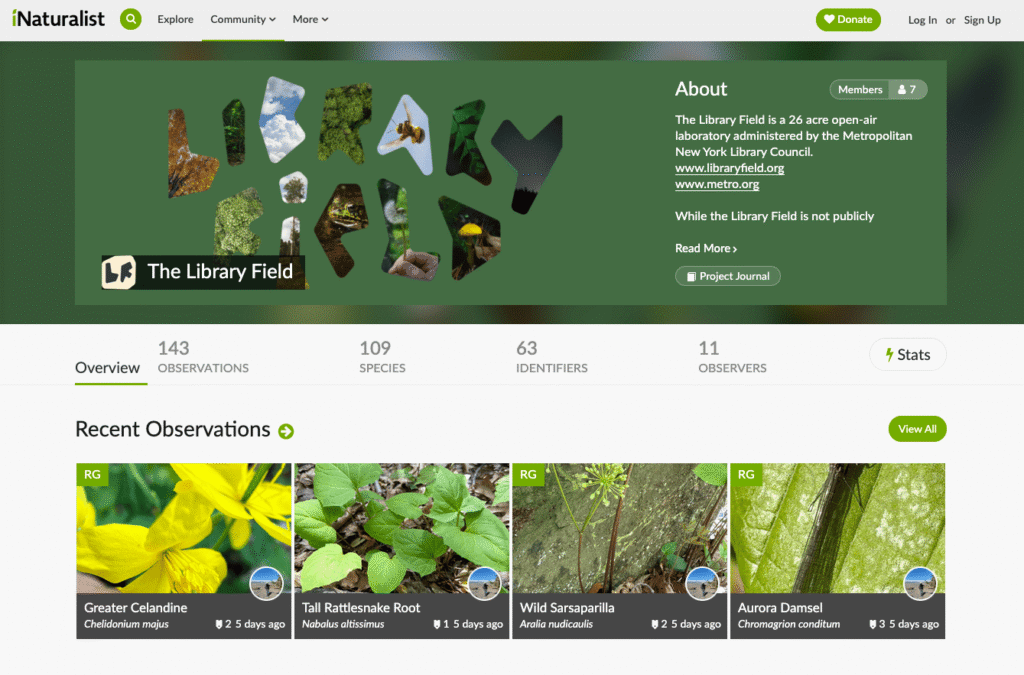
We are grateful to METRO for supporting us in conducting this project on a scientific basis, which will allow our efforts to more fully contribute to regional scientific knowledge. Rather than simply creating a checklist of the plants we find, Devon and I are collecting and pressing physical specimens that will be permanently vouchered in the herbarium at the New York State Museum. Westchester County is actually underrepresented in the botanical record of the state, and our project has the opportunity to help remedy that. Of course, we are also adhering to a philosophy of minimal impact: we will only collect as much as is needed, and only from a population that is healthy and numerous enough that we will not adversely affect it. So in addition to physical vouchers, we are also taking photographic vouchers that will be made public on the citizen science platform iNaturalist, and recording detailed information on each plant’s geospatial location, population characteristics, and habitat composition.
On to the field. As the land was slow to wake up for the first few weeks, we first acclimated ourselves to the physical character of the landscape. The Library Field is situated on an upland area of the eastern Hudson Valley that is finely divided into a series of roughly north-south trending rocky ridges and intervening valleys. The property’s historical owners added an access road, a trail system, and a number of structures, artificial ponds, and other minor alterations. Habitat-wise, a few general plant communities can be discerned. The ridge tops and upper slopes have good examples of a regionally characteristic chestnut oak forest; the lower slopes are more mixed, with various local compositions of northern and Appalachian hardwoods, conifers, and introduced trees. As is commonly the case with places that have seen recent human modification, a number of invasive species are present, tending to cluster around roads, structures, and along wetland corridors. Due to its hilly topography, there are no extensive wetlands here, but there are several pockets of wet habitats, including some ponds that are sure to have aquatic plants in them.
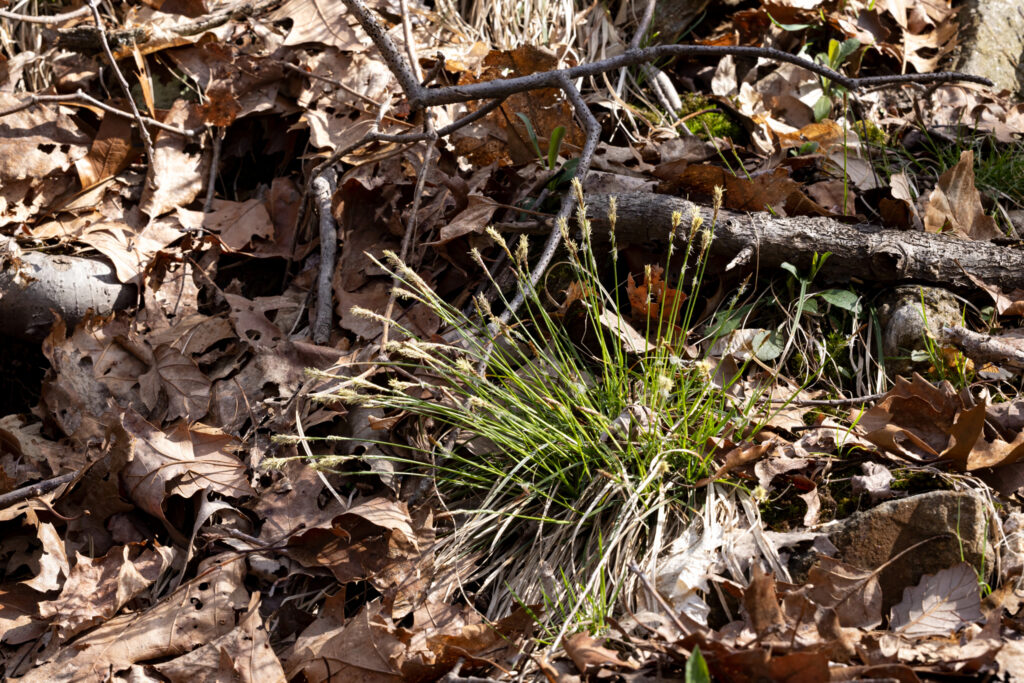
Over the last week, it’s been off to the races. The trees and bushes are leafing out and the herbaceous ground layer is rapidly emerging. Several kinds of early-season sedges and herbs are carpeting the forest floor. For Devon and I that means the real work has begun. Our first 25 collections are in the presses, with many more shortly to come. We found several healthy colonies of yellow trout lily (Erythronium americanum), but only one of them has yet been observed to produce flowers. Trout lily is a true spring ephemeral, meaning that it grows its vegetation only for a brief period in early spring, taking advantage of higher light availability before the canopy closes overhead. Soon all aboveground portions of these plants will die back, but their underground corms and stolons will remain, waiting for future springs.
We’ll keep you updated with our progress in a series of blog posts as the season progresses.